Off-Hand
A system that wraps Instagram with three quiet moments — one before, one during, one after. None of them block. All of them ask.
Eight people tried to scroll less. None of them stuck. All of them wanted to.
Every screen-time app on the App Store assumes you don't want to stop. That's why they take Instagram away. But the people who download these apps already want to scroll less — they're just losing the fight inside their own thumb. So I asked eight of them why their tools failed. The answer wasn't motivation. It was design.
Six of eight participants disabled their blocker for one task. All eight described the cycle as a personal failure. Five of eight raised bedtime scrolling, unprompted.
What kept surfacing across every conversation.
Forty minutes feels like five.
Users open Instagram for one task, get pulled into Reels, and surface forty minutes later remembering nothing. The failure isn't motivation — it's that the hand keeps moving while the mind goes elsewhere. They don't lose minutes. They lose themselves.
The block lasts until you need it not to.
All-or-nothing blockers break the moment a real need appears. A DM, a search, an event. Six of eight participants disabled their blocker for one task and never turned it back on. The blocker isn't fighting your weakness. It's fighting your life.
Restriction breeds workarounds. Reflection doesn't.
Two early concepts I tried fell apart for the same reason. Feature-level blocking still felt controlling. A physical phone charm was too easy to bypass. Tell a person no and watch them get clever. Ask them a question and they have to answer it.
From blocking to reflection.
Motivation to scroll less doesn't disappear during a session — it just gets out-paced by attention-capture patterns that operate faster than conscious deliberation. A blocker tries to substitute for that motivation by force, which is why users fight it. A reflection-based intervention does something different: it briefly slows the user back down to the speed of their own decision-making, where their existing motivation is already waiting.
The user already wants to scroll less. They just need a moment to remember.
The filter. Anything that violated it was set aside.
Reflection, not restriction.
Every intervention is dismissible in one tap. Nothing is ever blocked. The system works with the user's intent to stop, not against their access.
Reference the user's own intention.
Mirrors what the user said they wanted, never an external rule. The authority sits with the user, not the tool.
Make the gesture match the decision.
Reflex gestures produce reflex outcomes. Every meaningful choice is bound to a gesture that takes long enough for the conscious mind to catch up to the thumb.
Two directions I set aside. Both helped me see what wouldn't work.

Feature-level blocking
Block one Instagram feature after 9 PM of your choice. Too controlling. Still a blocker, just a more granular one. And users disagreed on which feature was 'the problem' anyway.
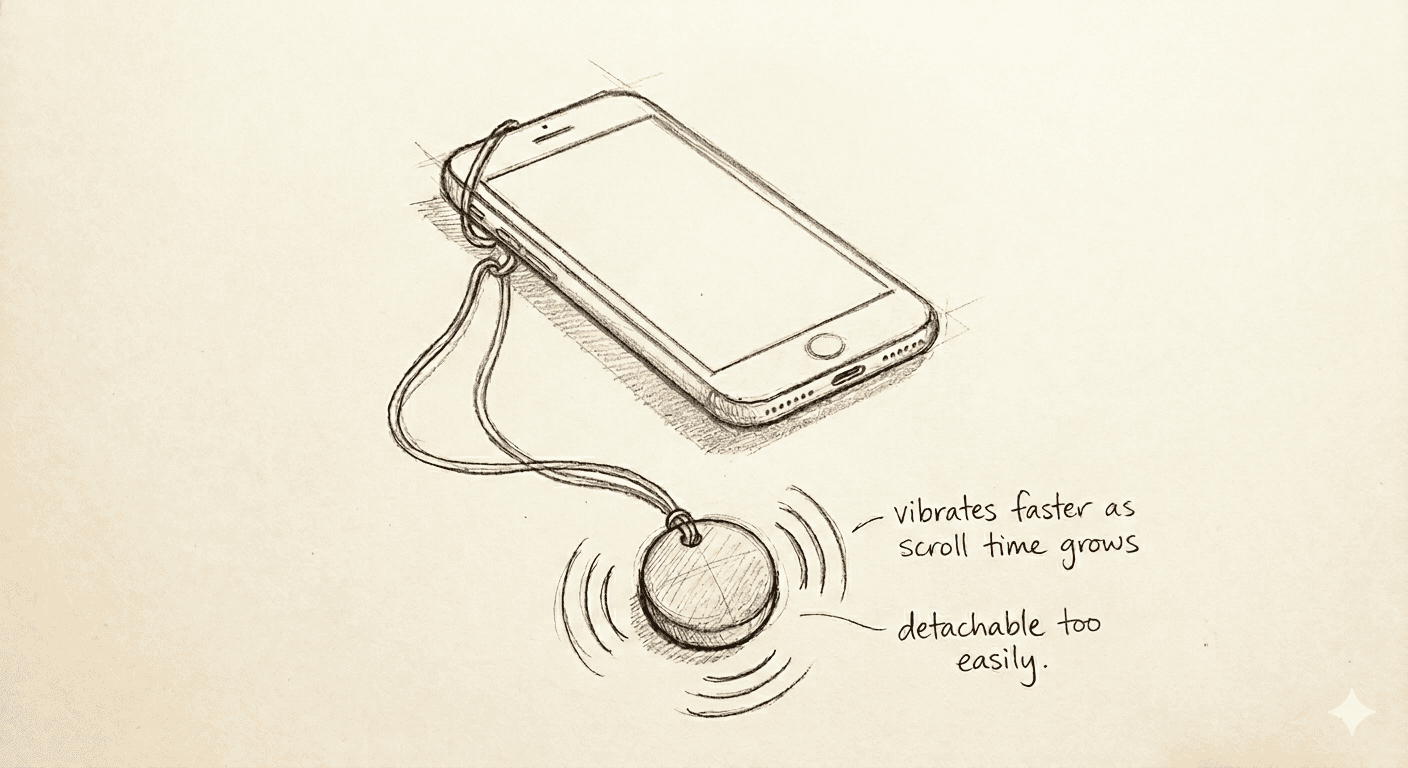
Physical phone charm
A charm that vibrates as scrolling time increases. Easy to bypass — users' first instinct was to detach it. Still nagging from outside, not surfacing the user's own intention.
One before, one during, one after.
Set your reason before you go in.
Three cards run between the tap and the feed, Instagram-Story style — auto-advancing, tap to skip, hold to pause. Card one is the receipt of the user's last session, generated from their own words. Card two is something more worth reading than scrolling. Card three is a slider asking what they came for, from reply to kill time. The chosen verb anchors everything that follows.
Hold the orb if you mean it.
Mid-scroll, the screen dims. A gray orb appears with the user's stated intent surfaced above it: 'You said you'd browse. How's it going?' Hold the orb for three seconds — haptics ramp, the orb warms gray to green, scales up — and you keep scrolling at the same position. Tap and walk, and you're out.
Most existing tools have a moment that looks like this — 'You've used Instagram for 30 minutes. Continue.' The user taps continue and the thumb learns the path within a few sessions. The reflection never happens. The hold makes the staying path slow enough that the choice gets made consciously. A tap is reflex. A hold is intention.
How was your session?
On the way out, one last screen. A short prompt — 'You came to browse' — followed by a four-stop slider with no neutral middle. The user drags, releases, and that verb is logged. It becomes the HOW IT WENT on the next session's receipt. The receipt is a ledger only the user reads, written in their own voice.
A working iOS app, not a Figma walkthrough.
Off-Hand runs as a working iOS app in React Native, tested through Expo Go on a real iPhone. It has its own home screen with the user's current orb state, an Archive of every receipt, and a Settings tab. The Demo button opens a fake iOS home where tapping Instagram fires the real Doorway — the closest a wrapper can get to intercepting Instagram on a platform that doesn't allow it.
Real Instagram is sandboxed.
iOS prevents apps from drawing on top of other apps. A real version would use the Screen Time API to fire the Doorway when Instagram launches and re-shield mid-session for the Check-in.
Habituation isn't proven.
Guideline 3 (gesture matches the decision) is the bet that a three-second hold is hard to make reflexive. Whether it actually slows the ignoring curve requires longitudinal study I haven't done.
Tested on Instagram only.
The model should generalize to TikTok, YouTube Shorts, X — but each has its own surface inventory that would need designing into.
What stuck with me, in order of importance.
Restraint is the work.
My instinct, repeatedly, was to add — more features, more data, more rules. The final concept is smaller than any of my early sketches and it's better because of that. Good design more often means less, placed better.
Suspect solution-shaped questions.
Going from 'what would make it work' to 'why are they abandoned' felt minor at the time. It changed everything downstream. I'm going to be more suspicious of solution-shaped questions at the start of the next project.
The goal isn't to fix anyone.
I kept feeling like a more aggressive intervention would be more useful. The research kept telling me the opposite. Restraint, here, isn't a weaker version of help. It's the actual help.